M.3 Revisión de una conciliación bancaria mensual elaborada por un contable

¿Qué es una conciliación bancaria y por qué debería revisarla?
La conciliación bancaria es un procedimiento que permite comprobar que todos los movimientos de entrada y salida de la cuenta bancaria quedan registrados en la contabilidad, y que todos los movimientos registrados en la contabilidad están reflejados en el banco.
La conciliación bancaria ofrece un control riguroso de tu cuenta bancaria para garantizar que todas las transacciones que entran y salen de ella sean correctas. Ten en cuenta que esto incluye, sobre todo, la detección de fraudes en los que puedan producirse retiradas no autorizadas; la conciliación bancaria es una de las formas clave de identificar estos problemas.
¿Cómo se revisa una conciliación bancaria?
Un paso fundamental en el proceso de conciliación bancaria consiste en revisar el extracto bancario, lo cual se lleva a cabo de forma independiente del proceso de conciliación bancaria. Como propietario o gerente, debes recibir los extractos bancarios cada mes y revisarlos, tomando nota de cualquier partida inusual o inesperada. Es posible que el contable reciba el extracto bancario al mismo tiempo. Una vez finalizado el proceso de conciliación bancaria, debes revisar el informe de conciliación.
Realiza este proceso para cada una de tus cuentas bancarias empresariales.
- Reúne tus informes:
- Informe de conciliación bancaria: solicítalo a tu contable o consíguelo directamente de tu sistema de contabilidad correspondiente al mes anterior.
- Extracto bancario: Obtén tu extracto bancario del mes anterior.
- Comprobar las fechas de conciliación:
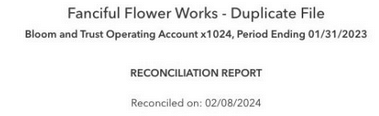
- Período de conciliación: Comprueba el informe para asegurarte de que abarca el período que finaliza el último día del mes anterior.
- Fecha de conciliación: Comprueba la fecha en la que se realizó la conciliación. Lo ideal es que se haya realizado en un plazo de diez días a partir del final del mes anterior.
- Si ha pasado un mes o más desde que finalizó el mes anterior, es probable que tu contable vaya con retraso. Si le facilitas la información puntualmente, deberías recibir los informes cada mes a tiempo. Pide a tu contable una explicación sobre cualquier retraso.
- Revisa tu informe de conciliación bancaria para comprobar los saldos:
- Declaración Inicio Saldo:
- Compara esta cantidad que figura en el informe con el saldo inicial de tu extracto bancario.
- Los dos números deben coincidir exactamente.
- Declaración Final Saldo:
- Compara esta cantidad que figura en el informe con el saldo final de tu extracto bancario.
- Los dos números deben coincidir exactamente.
- Qué hacer ante discrepancias: Si los saldos iniciales o finales de tu informe de conciliación bancaria y de tu extracto bancario no coinciden exactamente, hay un problema. Pregunta a tu contable por qué las cifras no coinciden.
- Declaración Inicio Saldo:

- Ve a la sección «Cheques y pagos liquidados»
- Echa un vistazo a toda la sección. ¿Ves algún concepto de importe elevado que no esperaras? ¿Se te ocurre qué podría ser? Si ves algún importe elevado inesperado:
- Pídele a tu contable que te muestre los detalles de esa cantidad.
- Asegúrate de entender bien su respuesta.
- Es posible que tengas que ponerte en contacto con tu banco para reclamar un cargo no autorizado.
- Por lo general, debes reclamar un cargo no autorizado a tu banco tan pronto como te des cuenta de él y en un plazo de 60 días. Algunos bancos establecen plazos más cortos o más largos para reclamar un cargo.
- Pídele a tu contable que te muestre los detalles de esa cantidad.
- Echa un vistazo a toda la sección. ¿Ves algún concepto de importe elevado que no esperaras? ¿Se te ocurre qué podría ser? Si ves algún importe elevado inesperado:
- Ve a la sección «Ingresos y otros abonos liquidados»
- Revisa esta sección para detectar pagos o ingresos de cuantía elevada, importantes o recurrentes que esperes recibir (por ejemplo, ingresos semanales del mercado de agricultores o un único pago de cuantía elevada de un cliente):
- Si falta un pago o un ingreso previsto, pregúntate: ¿por qué?
- En ocasiones, es posible que el pago se haya contabilizado en el mes anterior o en el siguiente.
- Sin embargo, si realmente falta un pago, es mejor saberlo lo antes posible para poder investigar qué ha pasado.
- Si falta un pago o un ingreso previsto, pregúntate: ¿por qué?
- Revisa esta sección para detectar pagos o ingresos de cuantía elevada, importantes o recurrentes que esperes recibir (por ejemplo, ingresos semanales del mercado de agricultores o un único pago de cuantía elevada de un cliente):
- Ve a la sección «Cheques y pagos pendientes»
- Busca en esta sección:
- Cheques con más de un mes de antigüedad: Plantéate si el destinatario ha perdido el cheque, se ha olvidado de ingresarlo o si tú mismo lo has anulado sin comunicárselo a tu contable.
- Cheques con más de seis meses de antigüedad: es posible que haya que volver a emitirlos, ya que es posible que los bancos no acepten cheques con más de seis meses de antigüedad.
- Nota importante: Los cheques pendientes de liquidación pueden liquidarse en cualquier momento. Tenlo en cuenta a la hora de consultar tu saldo bancario para determinar los fondos de los que dispones.
- Busca en esta sección:
- Cualquier partida pendiente de conciliar aparecerá como una categoría independiente para que puedas identificarla fácilmente. Asegúrate de liquidarlas al final de cada mes.