When and how farmers choose to become certified organic is complex, and every week some aspect of the decision comes up in our work with farmers and oftentimes landholders, too. We have come to understand their motivations for transition like price premiums, access to new markets, a healthy environment, and demonstrating ecological values for the farm’s customers.
Organic farming is one element of a spectrum of management choices and is the most clearly defined among good farming practices–from sustainable to regenerative. Organic certification in the U.S. is ruled by the USDA’s National Organic Program and operates under international trade law. This means that there is a legal definition for organic; when you see a product labeled “certified organic”, it means it went through a rigorous, third-party certification process. Ultimately, for most farmers, the choice to certify is driven by economics. For us, it’s not if our clients can invest in conservation, but how we can help make it happen.
In the winter months each year, we survey clients to understand how our work impacts their businesses and their satisfaction with our services. Early in 2026, our survey focused on conservation and financial resilience, and we received responses from 91 clients in 32 counties. One priority was to understand our clients’ conservation practices and needs to help shape our programs and support.
“FarmLink has been an enormous asset to my operation by ensuring financial stability and providing guidance to become a sustainable business.” - Survey response from Monterey County
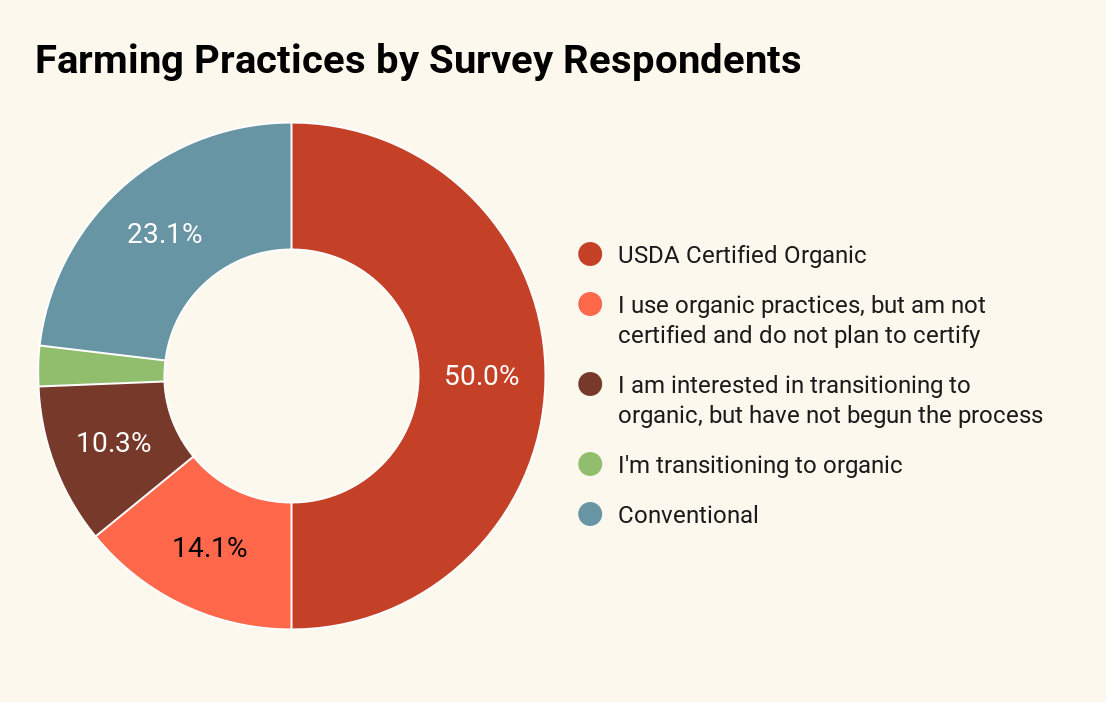
We found that 50% of the survey respondents are certified organic, 14% use organic practices without certification, and 10% want to become certified organic. We learned that essentially all the farmers, regardless of their organic status, use some form of conservation practices. The most common among them were compost applications (81%), cover crops (78%), crop rotations (60%), and minimum tillage (55%).
More than 10% of farmers indicated an interest in organic transition. Oftentimes those who would like to transition to organic perceive barriers such as paperwork and overall cost. For example, organic certification requires annual inspections, including an updated Organic System Plan, to verify practices. However, there are resources to help, including grants and other support from California Certified Organic Farmers (CCOF). Other concerns expressed by farmers included a lack of affordable organic inputs, prohibited materials drifting from neighboring farms, or uncertainty about the cost-benefit of organic certification. Farmers and ranchers who lack land security or operate on annual leases face additional challenges transitioning to organic. Because the organic certification process requires a three-year transition period, short term land tenure makes investing in the process risky if they’re unable to stay on that land. We work with landholders and landseekers to identify goals, including organic certification, and advocate for longer-term tenure and progressive lease rates to support up-front investments in soil health during the organic transition process.
Access to capital is another challenge organic and transitioning farmers face. Because many in our survey identified uncertainty around how an organic transition would affect their finances, it’s important for growers to know there are public grant programs to support the organic transition along with investments in soil and water management. FarmLink developed low-interest conservation loans to be part of the solution. Offered at 3.5% interest, the loans are designed to finance organic transition alongside grants and technical assistance programs. Conservation loans can provide the bridge financing needed between when a grower, operating with a conservation cost-share agreement or grant, needs to incur upfront costs before they are reimbursed. Most of the conservation loans we have made so far have supported irrigation projects funded by California’s State Water Efficiency and Enhancement Program, known as SWEEP, but there are also examples supporting organic transition, including recent good news about the state’s Organic Transition Pilot Program.
Overall, our records show that 35% of FarmLink’s borrowers are certified organic, a portion that’s seven times greater than the 4.7% of farms in California reported as certified organic in the most recent Census of Agriculture. With the most recent survey, we aimed to quantify how many clients use organic practices without certification. We found that 15% of the acreage is under organic practices without certification, and another 10% are considering an organic transition. Better understanding our clients’ land management practices and goals helps us to prioritize our programs and services.
We are proud to support organic transition. Earlier this year, we made a $30,000 conservation loan to cover costs to be reimbursed by a grant, including equipment like a seed drill for planting cover crops, compost spreader, and other supplies to optimize the farm’s organic transition. Additional equipment to improve soils could include a flail mower and spader to incorporate cover crops. With affordable financing and technical support, our staff and partners are ready to help more farmers improve soil health as a fundamental goal in regenerative and certified organic farming.
If you are looking to transition to organic, in addition to our discounted loans, learn about grants and other support that can benefit you.