The climate is changing. Humans enduring climate change is often compared to a frog in a pot on a stove. We take no notice until it is too late. The analogy needs a little update based on observations over the past few decades. The changes have not been incremental; they have been stochastic and jarring. Unpredictability like this is impossible to navigate and often has unforeseen consequences.
It does not take a logical stretch to connect the changing climate with updated oceanographic models, and the social and economic implications of these changes on the people who, often for generations, have depended on natural resources for their livelihoods. People like farmers and fishers.
Mitigating risk in the face of highly uncertain outcomes is challenging. Fishing communities often rely on each other’s goodwill to persist though hard times. Some have more formal practices in place, like local insurance pools. More recently, the California Ocean Science Trust has championed fisheries insurance with payouts linked to climate anomalies (OST, 2026). In most cases, however, fishers are left to fend for themselves in the face of adversity. California’s Dungeness crab industry, and the recent, climate-driven changes suppressing the fishery, provide a perfect example.

The recent troubles in California’s Dungeness crab fishery actually started years ago off the coast of Alaska. In 2014, seawater temperatures in the Northeast Pacific were much higher than usual (Figure 1), hampering the offshore krill blooms that sustain migrating humpback whales. Through 2015, the “warm blob” of seawater slid south along the coast, compressing the whales’ feeding areas to the nearshore shelf where delicious anchovies were thriving in cool, upwelled waters. As the whales amassed atop a continental shelf that had a healthy stock of Dungeness crab, California’s harbors were gearing up for the holiday crab season.
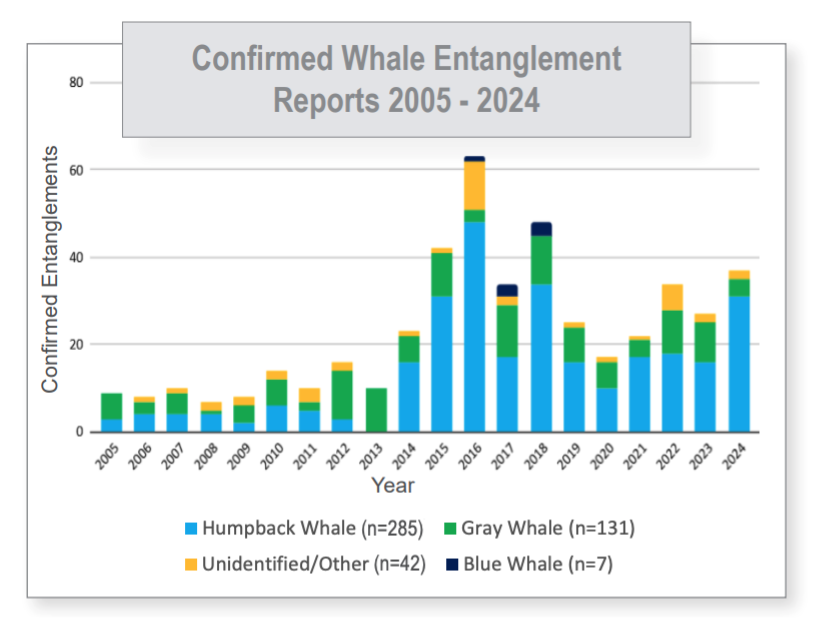
Holiday Crab Season is when the fleet catches almost all their crab, earning top dollar and often making or breaking their fishing business. In 2015-16, the fleet caught crab, but the increased presence of whales in the fishing grounds led to multiple instances of whales becoming entangled with the vertical ropes that connect crab traps on the ocean floor with their buoys on the surface. Up and down California’s coast, whale entanglements started spiking (Figure 2). People looked for someone to blame, and in the court of public opinion, crabbers were found guilty. The warm water also incubated a phytoplankton bloom that caused neurotoxins to accumulate in crab above safe levels, prompting a closure of the fishery in April 2015 that lasted almost a year. The value of crab landed in 2015 plummeted to $17M, compared to $67M the year before.
Today, to reduce entanglements, the California Department of Fish and Wildlife (CDFW) shortens the commercial Dungeness Crab fishing season and reduces the amount of gear that a fishing vessel can fish. Even with these restrictions, California’s commercial Dungeness crab fishery still presents a strong financial opportunity, though revenue is much more volatile. Year-to-year, landings have spiked or crashed by around 300% over the past decade. Though still potentially lucrative, it is a difficult business environment in which to operate. One FarmLink borrower compares it to gambling.
The pathway to reducing whale entanglement-related restrictions lies in inventing, testing, and adopting whale-safe fishing methods. California has done trials with several whale-safe fishing techniques over the past few years). All methods require changing fishing gear configurations from “one-pot” to “strings”, a major revision in crab vessel operations. The string configuration requires a lot more deck space to operate, since multiple pots are serviced at a time. The increased complexity increases crew entanglement hazards, so crews must remain extra vigilant while servicing pots. Finally, single pot configurations can be serviced by a single individual, while strings require a minimum crew of two.
These challenges are surmountable, and several crab operations have reported similar or better efficiency after switching to string configurations and working out the kinks. It has a much higher gear retrieval rate, with 2025 trials having no gear loss, compared to a 5-10% industry average.
A few whale-safe methods have been proposed. One involves no new technology. The vessel simply geotags the location of the pot string upon deployment, then uses a grappling hook to retrieve them. This method is easy to implement, inexpensive, and resilient to technology failures. Technology-dependent gear types are generally referred to as “pop-up gear.” The vessel sends an acoustic signal to the gear at the bottom, which then releases a line and buoy that pops up to the surface for retrieval (Figure 3). Pop-up gear is easy to implement and surprisingly resilient to failures when used properly. It is, however, expensive.

The cost of switching to pop-up gear is estimated to be from $40,000 to $90,000. Philanthropic organizations like the Euphotic Foundation are offering grants to subsidize the costs. Adopting whale-safe gear aligns strongly with FarmLink’s focus on environmentally sustainable and economically resilient food systems, so we are offering a special Conservation Loan at 3.5% interest to finance whale-safe gear, partnering with Euphotic on a streamlined application process to access both grants and loans for interested fishers. The discounted interest, two-season term, and fisher-friendly payment structure will help crabbers mitigate much of the risk associated with purchasing the gear.
CDFW is approving the use of whale safe gear for use this spring, but only if the crab season closes early on account of whales. Early adopters of safer gear are taking on incredible risk, making major expenditures well before an expected return. Whale-safe fishing will likely play an important role in the future of California’s crab fishery, and likely the future of other fisheries using vertical lines (e.g. coon stripe shrimp, black cod). Here at FarmLink, we will watch with bated breath as California’s first completely submerged Dungeness crab season unfolds this spring.
How you can help:
Buy local crab. For those near the Monterey Bay, the Monterey Bay Fisheries Trust has a thorough list of local spots. Follow their Instagram (@mbfishtrust) to hear about pop-ups and dockside sales.
Local Catch Network also has a great guide for finding local seafood nationwide.
Matthew Hess is a Loan Officer at California FarmLink
Sources
Alexander, K. and K. Williams (November 2014). Commercial crab season kicks off; let the holidays commence. SFGate. https://www.sfgate.com/bayarea/article/Tis-the-season-for-California-crab-5893895.php Accessed 02/12/2026.
Beccario, C. (February 2026). Earth.nullschool.net Accessed 02/12/2026.
California OST (January 2026). Congressional briefing on fishery disaster insurance. https://www.oceansciencetrust.org/in-practice/fishery-insurance-congressional-briefing Accessed 02/12/2026.
NOAA (April 2025). 2024 West Coast Whale Entanglement Summary. https://www.fisheries.noaa.gov/resource/document/2024-west-coast-whale-entanglement-summary Accessed 02/12/2026.
OPC (October, 2024). California Dungeness crab fishing gear working group. https://opc.ca.gov/california-dungeness-crab-fishing-gear-working-group/ Accessed 02/12/2026.
Stephens, T. (January 2020). Study connects marine heat wave with spike in whale entanglements. University of California, Santa Cruz News. https://news.ucsc.edu/2020/01/whale-entanglements/ Accessed 02/12/2026.