
Our nation’s farm and food policy dictates what crops farmers are incentivized to grow, how they grow them, where they sell them, and ultimately how much farmers earn. Policy also informs how farmers steward working landscapes and whether communities have access to clean water and air. As a mission-based agricultural lender, we understand how policy impacts access to financing and the knowledge and other resources farmers, ranchers, and fishers need to be successful.
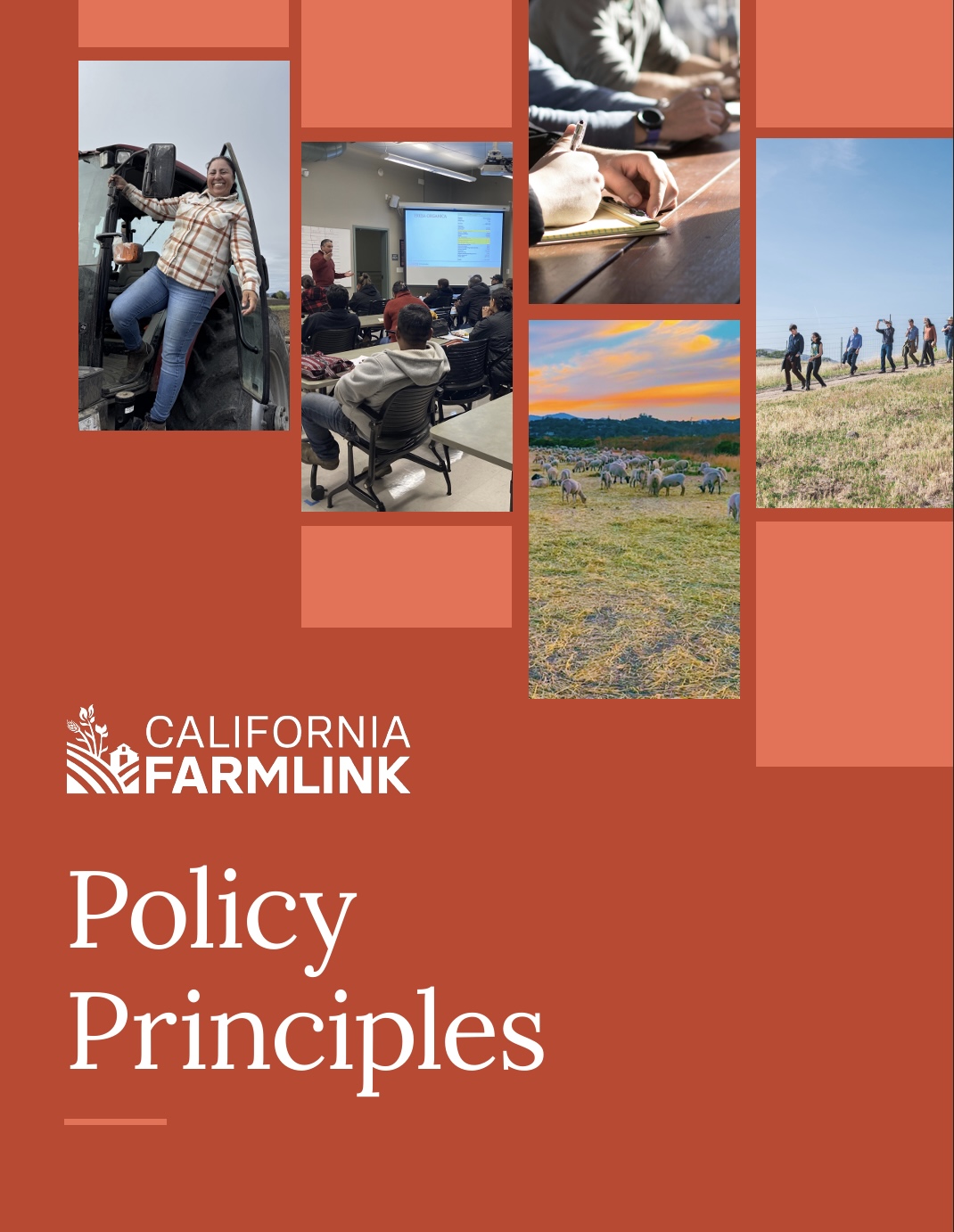
That’s why we are beyond excited to announce that California FarmLink has just released our first ever set of policy principles! These principles represent FarmLink’s broad positions or beliefs on policy issues that impact our clients and communities, and will serve as the foundation for FarmLink’s advocacy efforts at the local, state, and federal levels going forward.
You can find FarmLink's policy principles here.
Background
California FarmLink understands that the agricultural and financial systems we have today are shaped in large part by public policy decisions. As such, we have shown up at the policy table from our very beginning - offering ideas and solutions to address the challenges and lived experiences of the farmers we strive to serve. For example, FarmLink was instrumental in creating the USDA's Beginning Farmer and Rancher Development Program (BFRDP), which from 2009-2024 granted more than $300 million to support farmer education and technical assistance. We have also championed programs like California’s Investment and Innovation Program (Cal IIP) that supports access to fair financing for businesses with limited access to financial resources, as well as programs like the Rural Microentrepreneur Assistance Program (RMAP) that supports CDFIs like FarmLink to provide microloans and technical assistance to small businesses to support their resilience. For an overview of other public programs that have supported FarmLink’s work, check out Part II in our recent publication, What is an Agricultural CDFI?
Over the past several years, FarmLink has been dedicated to building out our policy program, with the aim of elevating the organization's impact to ensure state and federal policies and programs better reflect the needs of our unique constituency. Especially during the current political climate and the uncertainty of both federal and state resources for organizations like FarmLink and our clients, we believe it is now more important than ever to be stepping more fully into active policy debates at the state and federal level.
What are Policy Principles?
At their core, an organization's Policy Principles are statements of universal truth that guide future decision-making. FarmLink’s Policy Principles represent our broad positions or beliefs on relevant policy issues that impact our clients and communities. In some cases, our principles will guide FarmLink in taking clear and substantive actions, and in others they only represent guidance about which efforts, led by others, we will or will not support. They also provide a vision for how public policies can support FarmLink’s programs, services, and client communities.
Our principles articulate the core issues that are most important to FarmLink, and where we can be a resource for policymakers. It is our hope that these principles will help our partners, funders, and policymakers understand the boundaries of our work and what policies and programs are needed to ensure the success of the farmers FarmLink strives to serve.
Principles Overview
Our principles focus on six policy areas: 1) Agricultural Credit; 2) Building Wealth and Financial Resilience; 3) Land Tenure; 4) Climate Resilience; 5) Healthy Communities; and 6) Water.
Each of these policy areas has a corresponding policy goal that articulates what FarmLink is ultimately trying to achieve in the policy arena:
- Goal #1 - Ensure access to affordable, fair, non-predatory agricultural credit that meets the needs of low-income, beginning, and farmers of color and leverages their knowledge, experience and potential.
- Goal #2 - Create equitable opportunities for farmers, particularly communities of color, small-scale farmers, and those who have limited access to financial resources, to build wealth and achieve financial resilience.
- Goal #3 - Increase opportunities for farmers to acquire affordable, secure, long-term access to farmland, with an emphasis on beginning farmers, women farmers, and farmers of color.
- Goal #4 - Create equitable opportunities for farmers to conserve natural resources and lead in climate change adaptation, centering communities of color and those who have limited access to financial resources.
- Goal #5 - Expand support for farmworkers, food access, affordable housing, and disaster preparedness and recovery, and other policies that reflect the critical nexus between the health of communities and farmer livelihoods.
- Goal #6 - Ensure farmers and communities have access to water while also managing water resources sustainably to ensure long-term water security and a healthy environment.
Within each of these policy goals are statements of belief - our policy principles - that articulate not only core beliefs about what is needed to achieve that policy goal, but also illuminate the vision of the world that we are working towards.
For example, in support of our agricultural credit policy goal, we believe that “Agricultural credit should be affordable, fair, flexible, timely and accessible,” and that “All farmers, regardless of race, gender, religion, and country of origin, should have ready access to financing and related technical assistance and education in order to develop the knowledge and skills needed to build a financially sound farm or fishery business.”
While we outline six policy goals, FarmLink focuses its current policy efforts towards Priority Issues where we have the most capacity and expertise to engage (Goals 1 - 4), while following the lead of allies on Aligned Issues (Goals 5 and 6).
FarmLink’s Policy Positions
While not a comprehensive list of all possible positions FarmLink may take on specific policies, and legislation, our Policy Principles provide a roadmap for which policy issues FarmLink will endorse or oppose. Examples of specific policies that FarmLink supports include:
- Policies that support equitable land access
- Policies that facilitate farmer ownership of farmland
- Policies that incentivize agricultural business owners to save through retirement, college, and individual savings and investment accounts
- Policy mechanisms that seek to conserve and maintain the affordability of high quality farm and ranchland
- Policies that incentivize, support and remove barriers to transitioning the ownership of land and businesses to new owners, including women, farmers of color, and limited-resource producers
- Long-term investments in land stewardship and climate resilience
- Policies that support farmers and fishers in managing agricultural land and fish stocks for sustainable yields, and long-term health and resilience
- Climate policies that are farmer-centered, accessible and affordable to farmers of all scales, and are focused on practices with demonstrated climate outcomes
- Policies that incentivize and compensate farmers for ecosystem services, including mitigating the effects of climate change.
Our Policy Principles in Action
California FarmLink is already putting these policy principles to use in our current advocacy efforts at both the state and federal level.
In California, we are working with partners across the lending and small business communities to advocate for renewed funding for Cal IIP, which provides critical support to CDFIs like FarmLink to provide fair financing to small businesses across the state. We have also been deeply involved in the Governor’s Strategic Growth Council and its Agricultural Land Equity Task Force, and will be working with partners and legislators to advance the recommendations included in the Task Force’s recent report. We have also been tracking California’s Cap and Invest Reauthorization, and will be looking for opportunities to direct funding towards land access and climate solutions, such as our innovative solar-powered cooler pilot program. Finally, we are engaging with CDFA on their climate strategy for agriculture, and provided detailed recommendations and innovative ideas for how the state can better support small-scale farmers in combating climate change.
And nationally, we are engaging with our partners at the National Sustainable Agriculture Coalition on the ongoing farm bill reauthorization process, specifically advocating for policies like the Capital for Beginning Farmers Act which would extend greater flexibility and fill a key gap in financing a next generation of farmers. We are also working with partners to advocate for critical annual funding for programs like the U.S. Treasury’s CDFI Fund, USDA’s Rural Microentrepreneur Assistance Program, and its Intermediary Relending Program, which all provide essential capital for CDFIs like FarmLink and others to assist farmers and other rural businesses.
Acknowledgements
While we are committed to investing more resources towards policy solutions, we also know that we are stronger together, and place tremendous value on our partnerships and allies in cross-sector movements. We work closely with allies in the lending, small business, sustainable agriculture, and environmental sectors, and are working to become an even stronger ally. We also want to extend a huge thanks to all of our partners and funders for supporting this work, and helping us clarify where we can add the most value to the critical work that lies before us.
What’s Next
The moment that we, as a society, find ourselves in, demands a long-term vision for renewed public investment in effective policies and programs that support farmers’ prosperity and well-being. As one of the only community agricultural lenders in the country, we recognize the unique perspective and responsibility we have to contribute to policy conversations about the future of our food and agriculture systems. Our hope is that these policy principles will contribute to the collective work of building a more resilient and equitable future. We look forward to more policy updates on our progress in the months and years to come.
Juli Obudzinski is a consultant supporting public policy work at California FarmLink.